
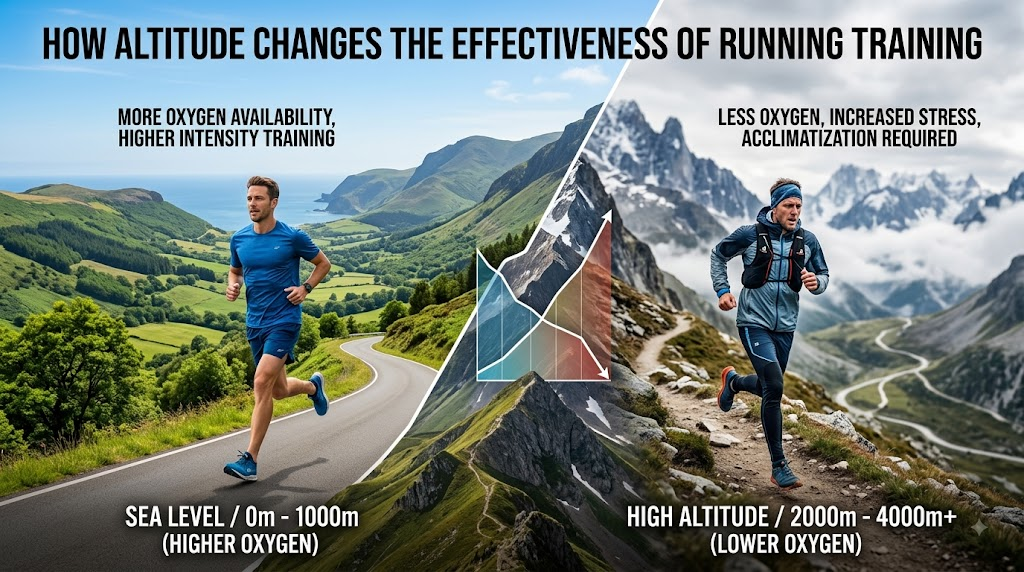
Altitude changes running training because lower air pressure reduces the amount of oxygen available with each breath. The percentage of oxygen in the air remains almost the same, but the pressure driving oxygen from the lungs into the blood falls as elevation increases. For runners, this means a familiar pace can require more effort, recovery can take longer, and the same workout may create a different physiological stimulus than it would at sea level.
This makes altitude training a problem of managing trade-offs rather than simply increasing difficulty. Athletes must judge when to reduce pace, when to preserve intensity, and how much recovery is required, just as users may adjust their choices when moving between different digital formats such as vortex aero turbogames. In running, however, the variables are measurable through heart rate, pace, blood oxygen response, perceived effort, and the quality of training completed across several weeks.
Lower Oxygen Availability Changes Aerobic Output
Endurance performance depends heavily on the ability to deliver oxygen to working muscles. At altitude, reduced oxygen pressure makes this process less efficient.
As a result, runners often experience a decline in maximal aerobic capacity after moving from sea level to elevation. A pace that previously sat below threshold may suddenly require greater cardiovascular effort. Breathing rate rises, heart rate can increase, and the athlete may reach fatigue sooner.
This does not mean fitness has disappeared. The environment has changed the cost of producing the same speed.
Coaches therefore need to separate external workload from internal workload. Pace shows how fast an athlete is running, while heart rate and perceived effort provide information about how much stress that pace is creating.
Training Pace Usually Needs to Decrease
One of the first adjustments at altitude is a reduction in training pace.
Easy runs should remain easy even if the watch displays slower numbers. Forcing sea-level pace can push a recovery run into a moderate or hard intensity zone and add fatigue that interferes with later sessions.
Threshold workouts may also need adjustment. The goal of a threshold session is to create a controlled metabolic stimulus, not to reproduce a specific pace regardless of conditions.
Interval work presents a harder problem. If athletes slow every session too much, they may lose some of the mechanical and neuromuscular stimulus associated with faster running. This is why altitude programming often requires careful decisions about which sessions should follow effort and which should preserve speed.
The Body Begins Adapting to Hypoxia
Repeated exposure to lower oxygen availability triggers a series of responses.
In the first days, ventilation increases and the cardiovascular system works harder to maintain oxygen delivery. Over longer periods, the body can increase production of erythropoietin, a hormone involved in red blood cell formation.
If exposure is sufficient and iron availability is adequate, some athletes may increase total hemoglobin mass. This can improve the blood’s capacity to transport oxygen when they return to lower elevation.
However, the response varies between athletes. Not everyone gains the same hematological benefit, and the effect depends on altitude, duration of exposure, iron status, training load, and individual physiology.
Altitude should therefore not be treated as a guaranteed performance enhancer.
Acclimatization Has a Cost
Adaptation does not happen without stress. The first period at altitude can reduce sleep quality, appetite, training tolerance, and recovery.
Runners who attempt normal mileage and normal intensity immediately after arrival may accumulate fatigue before useful adaptation occurs.
For this reason, the opening days of an altitude camp often involve lower volume or reduced intensity. Athletes need time to adjust before they can tolerate a full program.
The exact duration varies, but the principle is consistent: training should respond to the athlete’s current capacity rather than to a schedule created for sea-level conditions.
A runner who cannot recover from the workload will not benefit simply because the training is being completed at elevation.
Altitude Can Reduce Workout Quality
The main limitation of altitude training is that lower oxygen availability can reduce the speed an athlete can sustain.
This matters because running performance is not determined by aerobic capacity alone. Economy, neuromuscular coordination, stride mechanics, and the ability to run at race pace also need training.
If every hard session becomes substantially slower, the athlete may gain an aerobic stimulus while losing some race-specific quality.
This problem explains why some training models separate where athletes live from where they complete their hardest workouts. The aim is to gain exposure to altitude while preserving the ability to run selected sessions at a higher speed.
The effectiveness of this approach depends on geography, scheduling, and the athlete’s event.
Different Events Respond Differently
Altitude does not affect every runner in the same way.
Marathon and long-distance athletes may benefit from increased emphasis on aerobic adaptation because oxygen transport plays such a large role in their events.
Middle-distance runners also depend on aerobic capacity, but they need to maintain more speed. Excessive reduction in training velocity can therefore create a larger trade-off.
Sprinters experience less direct limitation from oxygen availability during short efforts, although recovery between repetitions can still change.
The ideal altitude strategy therefore depends on race distance. A program designed for a marathon runner should not automatically be applied to an athlete preparing for 800 or 1,500 meters.
Iron Availability Becomes More Important
Red blood cell production requires iron. If an athlete begins altitude exposure with low iron stores, the body may struggle to support the increase in erythropoiesis that altitude is intended to stimulate.
This is one reason endurance programs often assess iron status before altitude camps.
The issue is especially important for runners with high training volume or a history of low iron availability. Increasing altitude stress without addressing a limiting nutrient can reduce training quality rather than improve it.
Nutrition therefore becomes part of altitude programming rather than a separate topic.
Recovery Must Be Monitored More Closely
Training load should be evaluated through more than weekly distance.
At altitude, the same mileage can create greater internal stress. Athletes may need longer recovery between difficult sessions, more attention to sleep, and greater control of easy-day intensity.
Resting heart rate, perceived fatigue, workout quality, sleep, and changes in normal pace can provide useful information.
If several measures deteriorate together, the problem may not be a lack of effort. The athlete may simply be accumulating more stress than the body can absorb.
The aim of altitude training is adaptation, not exhaustion.
Returning to Sea Level Creates Another Transition
The end of an altitude block does not immediately produce perfect race performance.
Some athletes feel strong after descending because oxygen availability increases while altitude-related adaptations remain. Others initially feel awkward because faster paces place different mechanical demands on the legs.
Race timing therefore matters. Athletes may need several sessions after descent to restore rhythm at competition speed.
The ideal competition window varies, so coaches often use previous altitude blocks to understand how a specific runner responds.
Altitude Works Only When Training Quality Survives
Altitude can make endurance training more effective, but only if the added environmental stress is managed correctly.
Lower oxygen availability can stimulate useful adaptations, including changes in oxygen transport and cardiovascular regulation. At the same time, it can slow training pace, reduce workout quality, increase fatigue, and expose nutritional or recovery problems.
The value of altitude therefore comes from balance. Athletes need enough exposure to create adaptation without allowing hypoxia to damage the consistency and specificity of their training.
Altitude is not a substitute for good programming. It is another training variable, and its effectiveness depends on how precisely coaches integrate it with volume, intensity, recovery, nutrition, and race preparation.