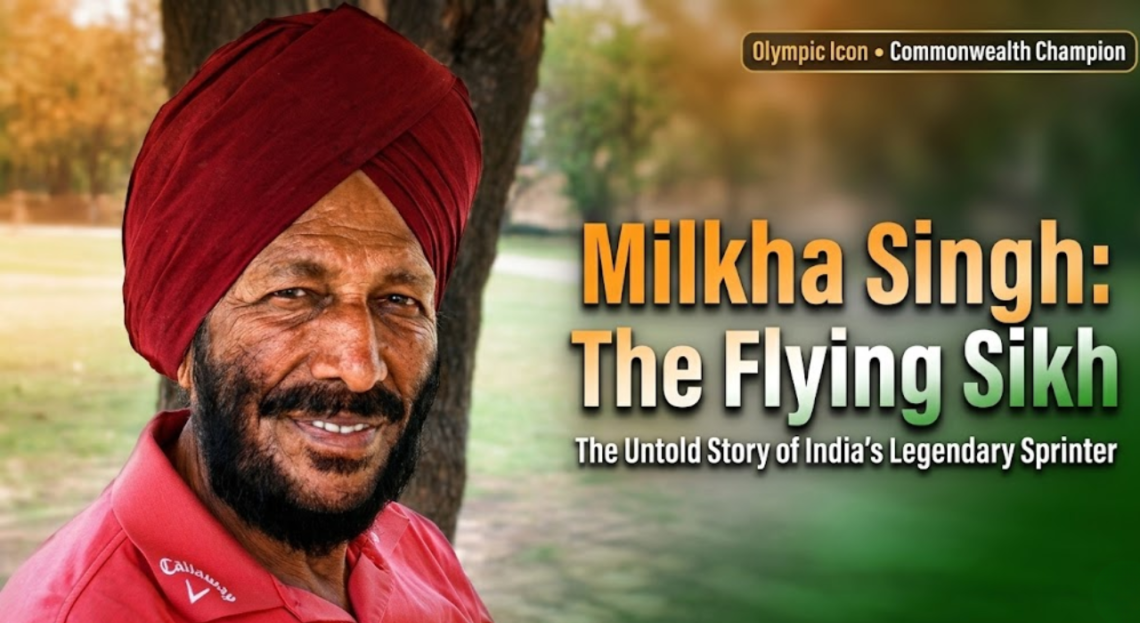
Some athletes win medals. Some win hearts. Milkha Singh did both and by doing so became much more than a sportsman. He became an emblem of a nation’s fortitude.”
Milkha Singh was born during the chaos of pre-Partition India, orphaned by communal violence and once briefly imprisoned for riding a train without a ticket; he would represent India in three consecutive Olympic Games and win gold medals at both the Commonwealth Games and Asian Games. His story, more than a Milkha Singh biography it is like a masterclass in turning tragedy into triumph.
Famously nicknamed “The Flying Sikh” a title bestowed upon him by Pakistan’s own President Milkha Singh was so fast: he seemed to be leaving the weight of his past behind with each stride. This article tells you all there is: his childhood, his records, his family, his legacy and the lesser-known facts that render him a truly legendary figure.
Personal Details
| Detail | Information |
| Full Name | Milkha Singh |
| Nickname | The Flying Sikh |
| Date of Birth | 20 November 1929 |
| Date of Death | 18 June 2021 |
| Age at Death | 91 years |
| Birthplace | Gobindpura (Muzaffargarh district), Punjab now Pakistan |
| Nationality | Indian |
| Religion | Sikhism |
| Profession | Track and Field Sprinter |
| Events | 200 metres, 400 metres |
| Olympic Appearances | 1956 (Melbourne), 1960 (Rome), 1964 (Tokyo) |
| Major Award | Padma Shri (1959) |
| Autobiography | The Race of My Life (2013) |
Early Life and Background
Instead of a race track, the life story of Milkha Singh starts in a destitute farming village Gobindpura, Muzaffargarh district, now in Pakistan. Milkha was born in a Sikh farming family on 20 November 1929, one of several children in a family where sport was not the priority; survival was.
Milkha found running completely by accident as a young boy. To escape the sweltering heat on the long walk to school, he would run from shade tree to shade tree building, unknowingly, the lungs and legs that would one day take him to international glory. He ran the distance of a full 10 km every time to and back from school on a regular basis going barefoot on dusty roads with no clue that these early years were forming the foundation of his athletic career.
Then came 1947, and everything fell apart with the Partition of India.
The communal bloodshed that followed the partition of the subcontinent, including the massacre of Milkha Singh’s parents and several siblings before his own eyes. Orphaned, traumatized and alone, the teenage Milkha ran to India with millions of other refugees. He had a domicile of his own at railway platforms, in refugee camps at Purana Qila and in resettlement colonies in Shahdara, Delhi.
It had gotten so bad that he hit Rock Bottom: he was arrested for riding a train without a ticket and spent time in Tihar Jail. His sister Ishvar pawned her jewellery to pay for his release. At one stage, he was seriously tempted to embrace a life of crime. His brother Malkhan turned him around and urged him to apply for the Indian Army instead.
That one bit of brotherly advice altered it all.
Milkha Singh Family and Relationships
In the mid-1950s, Milkha Singh met Nirmal Kaur captain of the Indian women’s national volleyball team and married her in 1963. In time, they created a family of four children: three daughters and one son.
Their son, Jeev Milkha Singh, became one of India’s greatest professional golfers the first Indian to qualify for the European Tour and the first Indian golfer to enter the world’s top 50. Jeev also won the Arjuna Award (1999) and the Padma Shri (2007), effectively making the Milkha Singh family one of Indian history’s most decorated sporting households.
In 1999, Milkha and Nirmal took in Havildar Bikram Singh’s seven-year-old son after his father perished in the Battle of Tiger Hill as part of Kargil War this was an act of kindness that says a great deal about the man beyond the medals.
In what amounted to a tragic postscript to the Milkha Singh biography, both Milkha Singh and his dearly loved spouse Nirmal died within days of each other in June 2021 of COVID-19. Nirmal passed away on 13 June, 2021, and Milkha followed soon after on the 18th. He was cremated holding a photograph of Nirmal.
The Army
Before getting into the Indian Army, Milkha Singh had applied for it thrice. He succeeded eventually in 1951 and was posted to the Electrical and Mechanical Engineering (EME) Centre then at Secunderabad.
His moment of revelation came early during a routine compulsory cross-country run for new recruits, Milkha placed sixth out of 500 soldiers. That performance impressed his commanding officers, who promptly put him into special athletic training. The army provided him with structure, discipline and a path and Milkha supplied the army, and India, a legend.
He practiced with a ferocity that shocked even his coaches. He jogged in hilly places, on riverbanks and occasionally raced a metre-gauge train to build speed and endurance. For almost three years, he trained barefoot. His sessions were sometimes so extreme he’d collapse from exhaustion. But every morning, he returned to the track.
Milkha Singh Athletic Career
1956 Melbourne Olympics The First Test
Milkha made it to his maiden Olympic Games in 1956 held at Melbourne where he participated in 200m and the 400m events. His naivety was evident he failed to make it through the heats but a chat with Charles Jenkins, the American who went on to win gold in the 400m, provided him with invaluable technical insight on training methods. He went back to India with a singular goal: turn into a “running machine.”
1958 The Year That Defined Him
Fifty-eight was Milkha Singh’s annus mirabilis. In rapid succession, he:
- Won National Games of India in Cuttack, Set national records at 200m &400m
- Won Asian Games gold medals in the 200m and 400m beating Pakistan’s Abdul Khaliq.
- Won gold in the 440 yards (400m) at the British Empire and Commonwealth Games in Cardiff with a time of 46.6 seconds becoming the first Indian male to win an individual athletics gold medal at the Commonwealth Games
It made particularly impressive reading his Commonwealth gold. Milkha had been running in the less favorable outside lane and put on a surge to pass rivals from around the British Empire. The mood in India was electric. Newspapers called him a village man who had run the race barefoot and did not know how to spell “athletics” yet had beaten the world’s best.
The Race in Pakistan Birth of a Legend
In 1960, Prime Minister Jawaharlal Nehru himself convinced Milkha to put aside the bitter memories of Partition and running in Pakistan. Milkha agreed. More than 70,000 fans packed the stadium in Lahore to see him go against Abdul Khaliq.
Milkha won. As they watched from the stands, Gen. Mohammad Ayub Khan, then the president of Pakistan, turned to a member of the Indian delegation and said: “You didn’t run today you flew.” And thus was born “The Flying Sikh.”
1960 Rome Olympics The Race He Never Forgot
There has been a lot of talk about what happened in the 1960 Rome Olympics where Milkha Singh’s career’s most controversial moment is featured. One of the favourites for the 400m final, Milkha had suspected that he was leading through the first 200 metres. Then in a moment he would later cite as the biggest regret of his life he looked back at his rivals. He relaxed instinctively, and the pack overtook him.
He placed fourth at 45.73 seconds one-tenth of a second short of the bronze medal in a race that required a photo finish to determine the order. But that time remained an Indian national record for almost 38 years.
1962 Asian Games One Final Blaze
For proof, Milkha excelled at the 1962 Asian Games in Jakarta, where he claimed gold in the 400m and was a member of the gold medal-winning 4×400m relay team. To date, he is also the only Indian athlete ever to have won gold in 400m at both the Commonwealth Games as well as the Asian Games.
Major Achievements and Records
| Year | Event | Achievement |
| 1958 | Asian Games, Tokyo | Gold 200m & 400m |
| 1958 | Commonwealth Games, Cardiff | Gold 440 yards (first Indian male to achieve this) |
| 1960 | Rome Olympics | 4th place 400m (national record: 45.73 seconds) |
| 1962 | Asian Games, Jakarta | Gold 400m & 4×400m relay |
| Career | International races | 77 victories out of ~80 international races |
Milkha Singh Awards and Honors
- Padma Shri (1959) India’s fourth-highest civilian award, awarded for his accomplishments in sports.
- Director of Sports, Punjab After retiring Milkha served as Punjab’s Director of Sports, moulding the next generation of athletes.
- Madame Tussauds Wax Statue In 2017, a wax figure of Milkha Singh was unveiled at Madame Tussauds Delhi.
- Bhaag Milkha Bhaag (2013) His story inspired this critically acclaimed and commercially successful Bollywood biopic by director Rakeysh Omprakash Mehra, in which Farhan Akhtar plays the part of Milkha Singh. He sold its film rights for a nominal ₹1 and asked that the note be one from 1958, when he won gold in Commonwealth.
- The Race of My Life (2013) Co-written with his daughter Sonia Sanwalka, this autobiography became a national bestseller.
Milkha in fact donated his all gold medals to the nation. After their initial exhibition at the Jawaharlal Nehru Stadium in New Delhi, they were transferred to a sports museum at Patiala.
Milkha Singh Net Worth
Milkha Singh was not a commercially oriented athlete by modern standards. The bulk of his income throughout his career was a generalized salary he received from the Indian Army, and later as Director of Sports in Punjab’s Ministry of Education a position he held until retirement around 1998.
He was believed to own property worth as much as ₹5–10 crore (approximately $600,000–$1.2 million) at the time of his deathincluding his residence in Chandigarh and other personal assets he had accumulated after decades in public life.
He was especially generous with his fortune giving away medals to the state, underwriting film rights for one rupee and even adopting a martyr’s son. He also founded the Milkha Singh Charitable Trust, which helps underprivileged athletes and sports infrastructure.
Social Media Presence
In later years, Milkha Singh himself had very little digital footprint, apart from his son Jeev Milkha Singh and other family members sharing updates or tributes on social media. Since his death in 2021, he is kept alive by:
- Family-run official pages.
- PSA campaigns invoking his legacy, especially concerning fitness and athletics among young people.
- Bhaag Milkha Bhaag fan community on YouTube, Instagram and Twitter/X
His story continues to trend during national sporting events and India’s Olympic campaigns, slipping the bonds of algorithm some legacies know no algorithm.
Interesting Facts about Milkha Singh
- The Indian Army rejected him three times, before accepting him in 1951 on his fourth attempt.
- During the first three years of his army training, he ran barefoot, before moving to spiked shoes.
- The deal for the ₹1 film rights in fact included a special request the rupee note had to be printed in 1958, when he won Commonwealth gold.
- His national 400m record of 45.73 seconds (during the 1960 Rome Olympics) stood unbroken for 38 years till Paramjit Singh beat it in 1998.
- He gave all his medals to the government they are now displayed in Patiala at the National Sports Museum.
- Milkha died in June 2021, a death also claimed by COVID-19 complications; his wife Nirmal followed five days later.
- He was once in a position to win the Arjuna Award outright, but he refused it on the grounds that it should go to younger athletes still competing.
- He sprinted to 77 international victories over his career a staggering achievement for any sprinter of any era.
Legacy and Lasting Impact
Milkha Singh passes away in June 2021 and his legacy continues to loom large on Indian sport. He was not simply an athlete he was the evidence that greatness blooms in the unlikeliest of dirt.
Every Indian sprinter who puts on a pair of shoes carries a small piece of his story with them. His portrait is displayed in schools, military barracks and sports academies throughout India. His autobiography adorns innumerable coaching centres across the country. And whenever there’s an Indian runner on the start line at an Olympics, commentator still references his name not as a specter of prior failure but as the gold standard for grit.
FAQs
1. Why is Milkha Singh called “The Flying Sikh”?
The title was given to him by Pakistani President General Ayub Khan after Milkha defeated Pakistan’s ace sprinter Abdul Khaliq in Lahore in 1960, prompting Khan to say, “You didn’t run today you flew.”
2. Did Milkha Singh ever win an Olympic medal?
No. His closest Olympic moment came at the 1960 Rome Olympics, where he finished fourth in the 400m final missing the bronze medal by just one-tenth of a second. However, his time of 45.73 seconds set an Indian national record that stood for 38 years.
3. What is Milkha Singh’s greatest achievement?
Winning the 400m gold at the 1958 Commonwealth Games in Cardiff, making him the first Indian male to win an individual athletics gold medal at the Commonwealth Games. He also holds the distinction of winning gold at both the Commonwealth Games and the Asian Games in the 400m.
4. Who is Milkha Singh’s son?
His son, Jeev Milkha Singh, is a celebrated professional golfer the most successful Indian golfer in European Tour history and a recipient of both the Arjuna Award and Padma Shri.
5. What is the name of Milkha Singh’s autobiography?
His autobiography is titled The Race of My Life, co-authored with his daughter Sonia Sanwalka and published in 2013 by Rupa Books.
6. Which Bollywood film was made on Milkha Singh’s life?
The 2013 biographical film Bhaag Milkha Bhaag, directed by Rakeysh Omprakash Mehra and starring Farhan Akhtar as Milkha Singh. He sold the rights for a symbolic ₹1, requesting the note be from 1958.
7. When and how did Milkha Singh die?
Milkha Singh passed away on 18 June 2021 at the age of 91 in Chandigarh due to complications from COVID-19. His wife Nirmal had died just five days earlier, also due to COVID-19.
Read more : Shubhman Gill | Neeraj Chopra Biography | Mary Kom Biography